
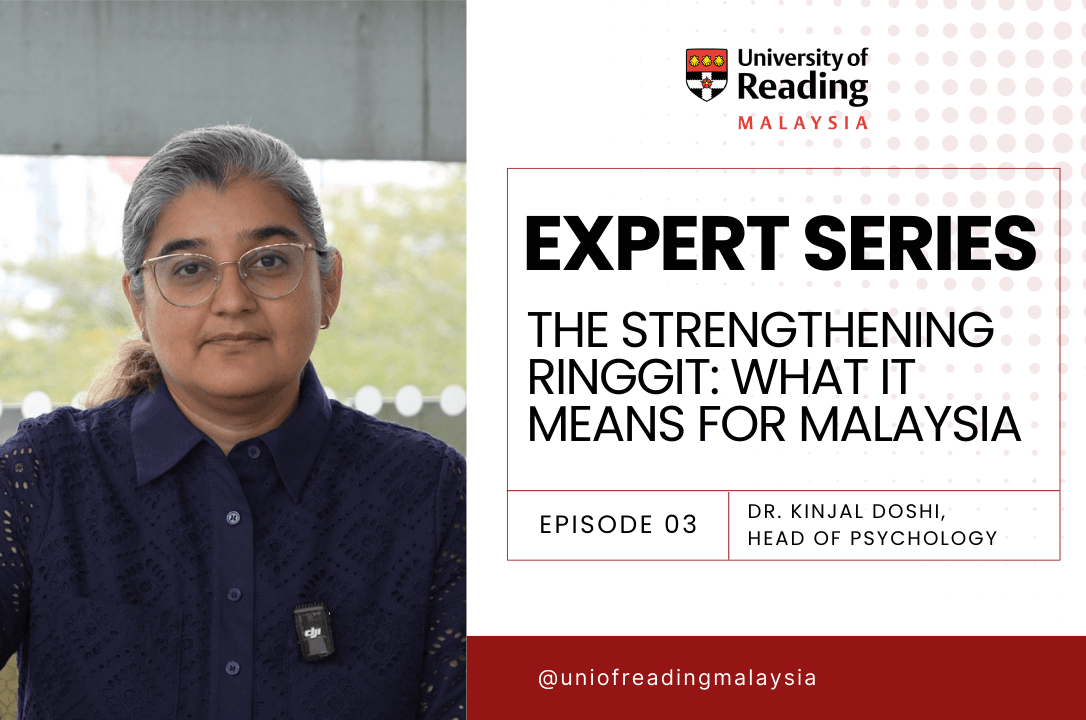
Why Malaysians Still Feel the Economy Is “Tight”, Even with a Stronger Ringgit
by Prof. Dr Kinjal Doshi,
Head of Psychology
In recent months, reports of a strengthening Ringgit have been widely shared as a positive sign for Malaysia’s economy. Stronger currency performance is often associated with improved stability and easing inflation. Yet for many Malaysians, daily life still feels financially tight. Spending remains cautious, and household budgets continue to feel strained.
This gap between economic indicators and lived experience highlights an important reality: economic recovery is not just a financial process, but a psychological one. Understanding how people perceive and respond to economic change helps explain why confidence often takes longer to return than the numbers suggest.
Why a Stronger Ringgit Does Not Instantly Change Perceptions
From a macroeconomic perspective, a strengthening Ringgit reflects improving fundamentals, better investor confidence, and stabilising price pressures. However, individuals and families do not experience these shifts immediately. Financial decisions are deeply shaped by past experiences, particularly periods of economic stress.
When prices rise sharply or budgets tighten, the emotional impact is felt quickly. Even when conditions begin to improve, people remain cautious. This hesitation is not irrational, it is a natural psychological response to uncertainty.
Anchoring: How Past Experiences Shape Today’s Behaviour
One key psychological concept that helps explain this behaviour is anchoring. Anchoring refers to our tendency to rely heavily on past experiences when evaluating new situations.
For many Malaysians, memories of higher food prices, rising living costs, and financial uncertainty remain vivid. These experiences become mental reference points. Even when inflation slows or the Ringgit strengthens, people continue to assess their financial situation against those earlier, more challenging periods.
As a result, improvements in the economy may be acknowledged intellectually, but they are not immediately trusted emotionally.
Loss Aversion and the Slow Emotional Recovery
Another important factor is loss aversion, a well-established principle in behavioural psychology. Loss aversion explains why people react more strongly to losses than to gains of the same size.
When the cost of living increased, households felt the impact almost immediately. Financial stress, spending cuts, and heightened anxiety followed quickly. However, when conditions stabilise, the emotional recovery takes longer. People do not instantly feel better simply because prices stop rising.
This is why many Malaysians continue to feel cautious even as economic indicators show improvement.
How Psychology Shapes Spending and Consumer Confidence
Psychological responses directly influence consumer behaviour. When confidence is low, people are more likely to delay purchases, reduce discretionary spending, and maintain strict budgets, even when economic conditions begin to stabilise.
This explains why consumer confidence does not rebound the moment the Ringgit strengthens. A stable currency alone is not enough. People need consistent, repeated signals before they feel secure enough to adjust their spending habits.
Why Stability Over Time Matters
From a psychological perspective, trust is rebuilt through consistency. As the Ringgit remains strong and economic stability continues, expectations gradually adjust. Over time, households begin to feel safer, spending patterns loosen, and confidence slowly returns.
This highlights a key insight for policymakers, businesses, and institutions: economic recovery is not only about improving indicators, but about rebuilding trust and emotional security.
Conclusion
While the strengthening Ringgit is a positive sign for Malaysia’s economy, emotional recovery naturally lags behind economic improvement. Concepts such as anchoring and loss aversion explain why many Malaysians continue to feel financial pressure even as conditions stabilise.
At the University of Reading Malaysia, our Psychology programme examines how human behaviour shapes decision-making across society, including economic and financial behaviour.
Discover more expert perspectives from UoRM by exploring our Expert Series or contact us to learn more about studying Psychology at UoRM.