
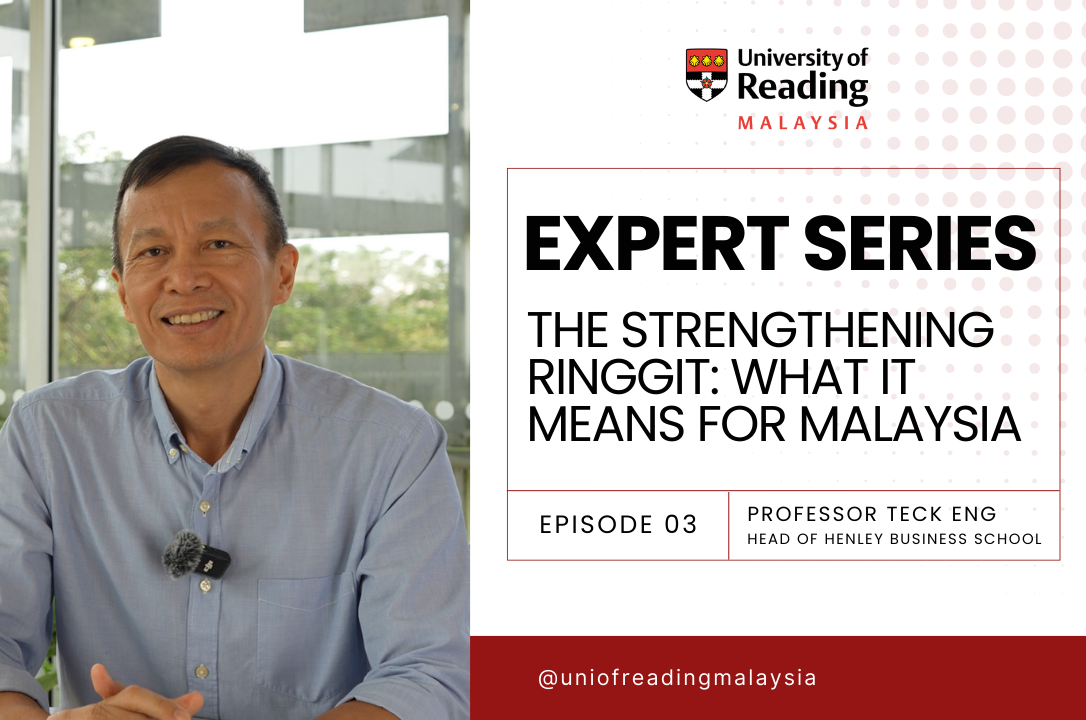
How a Strengthening Ringgit Impacts Malaysian Businesses
by Professor Teck Yong Eng,
Professor of Business Enterprise & Analytics,
Head of Henley Business School Malaysia
As the Ringgit continues to strengthen against major global currencies, Malaysian businesses across sectors are experiencing ripple effects, some immediate and others more structural. Exchange rate movements influence import costs, export competitiveness, investment appetite, and long-term planning. This expanded analysis from Henley Business School Malaysia explores the forces behind the Ringgit’s recovery, its implications for industries, and how organisations can position themselves strategically in a changing economic environment.
A stronger Ringgit is typically a reflection of improving national fundamentals, from stable governance and inflation control to healthier trade performance and investor sentiment. However, the impact is not uniform. Import-dependent companies may benefit immediately, while exporters may need to refine their competitive strategies. Below, we break down the key drivers and practical business implications.
What Is Driving the Ringgit’s Recovery?
The currency’s appreciation reflects interconnected economic and policy developments. Understanding these drivers helps businesses interpret the broader operating landscape and adjust future strategy.
Improving economic fundamentals and trade performance
Malaysia’s economy continues to benefit from strong demand in key export sectors including E&E manufacturing, commodities, and professional services. As global supply chains stabilise, export consistency helps strengthen the balance of payments and reduces volatility, contributing to a firmer Ringgit.
Clearer policy direction and fiscal discipline
The government’s ongoing work on subsidy rationalisation, targeted social support, and improved public finance management has contributed to renewed investor confidence. When fiscal frameworks are predictable and governance is strong, it strengthens external perceptions of economic stability which supports the Ringgit.
Increased investor confidence and capital inflows
Malaysia’s strategic location within ASEAN, combined with improved policy clarity, continues to attract foreign direct investment and portfolio inflows. Capital entering the local market strengthens the currency through greater demand, while also acting as a signal of confidence in Malaysia’s long-term growth prospects.
How a Stronger Ringgit Affects Malaysian Businesses
The impact of currency appreciation differs across sectors. While importers may experience cost advantages, exporters may need to adjust their strategic positioning. Across industries, planning and agility become critical.
Lower import expenditure and operating costs
Businesses reliant on imported components, machinery, or raw materials benefit from reduced input costs when the Ringgit strengthens. This may free up capital for innovation, digitalisation, and workforce development. Over time, this supports productivity growth, especially among SMEs.
Competitive pressures for export-driven sectors
Exporters may face price-based competition as Malaysian goods become relatively more expensive abroad. However, this shift encourages companies to move up the value chain by emphasising branding, innovation, service differentiation, and product quality. Long-term competitiveness depends increasingly on innovation rather than cost alone.
A more favourable environment for long-term investment
Currency stability reduces uncertainty, enabling firms to commit more confidently to expansion projects, technology upgrades, and workforce upskilling. Investment-heavy industries, including real estate, technology, logistics, and financial services will benefit significantly from a predictable macroeconomic environment.
Strategic Considerations for Businesses Moving Forward
To navigate the evolving economic environment, organisations must reassess strategies, innovation priorities, and resilience planning. Henley Business School identifies several areas for strategic focus.
Reevaluating pricing, market positioning, and value creation
With narrowing price advantages, businesses should shift toward higher-value offerings, differentiated services, and innovation-led competitiveness. Strengthening brand equity and customer experience will be essential.
Building supply chain resilience and quality improvements
Lower import costs create an opportunity to diversify suppliers, upgrade materials, and improve operational reliability. Stable input pricing can support better forecasting and reduce operational risk.
Investing in talent, digital capabilities, and leadership development
A stable business environment supports long-term investments in leadership and capability-building. Henley Business School’s internationally recognised programmes help organisations develop leaders equipped for strategic transformation, digital growth, and complex economic environments.
Conclusion
The strengthening Ringgit marks an important moment for Malaysian businesses. While some sectors stand to benefit immediately from easing import costs, others may need to adjust strategies and innovate to remain competitive. With clearer economic direction and renewed investor confidence, organisations have a valuable opportunity to reposition themselves for long-term growth. By focusing on resilience, talent development, productivity, and innovation, Malaysian companies can thrive in this strengthening economic landscape.
Learn more about our programmes at Henley Business School Malaysia, explore our programme options, or contact us for guidance on advancing your career in today’s evolving business environment.