
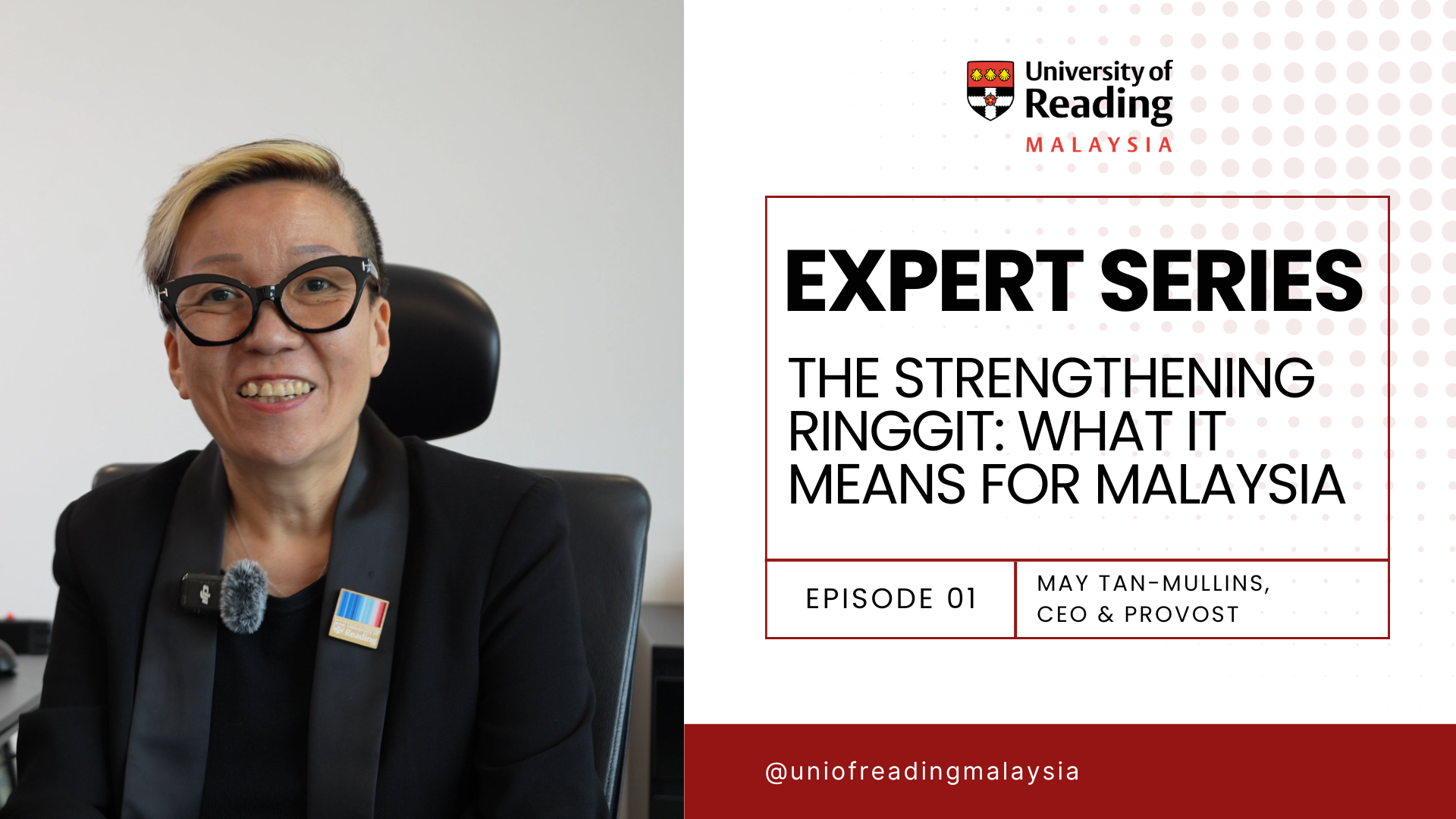
Strengthening of the Ringgit: What It Means for Malaysia
by Professor May Tan-Mullins,
Provost & Chief Executive Officer, University of Reading Malaysia
Malaysia is experiencing a period of renewed economic optimism as the Ringgit strengthens against major global currencies. While exchange rates can feel technical and removed from daily life, their movements have real implications for households, businesses, and sectors such as higher education. This article expands on the Provost’s expert perspective. Examining the drivers behind the Ringgit’s recovery, the practical consequences for Malaysians, and what the future might hold if current trends persist.
The recent upward trend in the Ringgit is not the result of a single event but a combination of improving economic fundamentals, clearer policy direction, and renewed capital flows. Taken together, these factors suggest greater macroeconomic stability and a more favourable environment for investment, consumption, and long-term planning. Below, we explore these elements in detail and outline how different segments of society could benefit.
What Is Driving the Ringgit’s Recovery?
The Ringgit’s recovery is the product of multiple, mutually reinforcing trends. Understanding these drivers helps contextualise the currency movement and clarifies why its effects extend beyond foreign-exchange tables into everyday economic life.
Stronger trade and economic fundamentals
Malaysia’s diversified export base, including electrical and electronics manufacturing, palm oil and other commodities, and an expanding services sector, has supported external resilience. As global supply chains gradually stabilise after pandemic disruptions, demand for Malaysia’s exportable goods and services has become more predictable. This steadier trade performance underpins currency strength by improving the balance of payments and reducing downside volatility associated with external shocks.
Improved governance and policy clarity
Fiscal reforms, clearer policy communication, and measures to enhance transparency have helped restore investor confidence. Actions such as prudent public finance management, targeted subsidy rationalisation, and efforts to broaden the tax base demonstrate a commitment to long-term sustainability. Markets value predictability: when policymakers provide coherent signals about the country’s direction, capital allocators respond more favourably and supporting the currency as a result.
Renewed investor interest
As global capital seeks productive opportunities in the region, Malaysia’s combination of strategic location, competitive costs, and improved policy stability has attracted attention. Increased foreign direct investment and portfolio inflows contribute to demand for the Ringgit, providing an important source of support. This capital inflow often acts as both a signal and a mechanism: it signals confidence and mechanically strengthens the currency through FX market activity.
What This Means for Malaysian Households
Currency movements affect everyday life in concrete ways. For many families, the improving Ringgit can bring practical relief, particularly where imported goods or services play a significant role in household budgets.
Lower import costs and consumer prices
A stronger Ringgit reduces the domestic price of imported items, from food staples and medical supplies to electronics and raw materials for manufactured goods. Over time, this can ease price pressures across retail categories and improve the purchasing power of households which contributes to a gradual reduction in the cost of living.
Moderation of inflation
When import prices stabilise, inflationary momentum tends to weaken. Slower inflation helps households plan expenses such as schooling, healthcare, and housing with greater certainty. This can be particularly meaningful for middle-income families who feel the cumulative effect of price increases most acutely.
Improved confidence for long-term planning
Currency stability reduces uncertainty, which is critical for decisions like saving for higher education, making down payments on property, or planning retirement contributions. A predictable exchange-rate environment supports better financial planning and can reduce the need for costly hedging or last-minute adjustments to household budgets.
Implications for Businesses and the Wider Economy
Businesses will experience the Ringgit’s strengthening differently depending on their exposure to international markets, input sourcing, and pricing strategies. Overall, the movement creates both opportunities and strategic imperatives.
Lower input costs for import-dependent sectors
Manufacturers, retailers, and service providers who rely on imported components or equipment benefit from reduced costs. Lower input prices can improve margins, free resources for investment, and allow businesses to invest in efficiency improvements or workforce development.
Pressure and opportunity for exporters
A stronger Ringgit can make exported goods relatively more expensive in foreign markets, creating competitive pressures for price-sensitive sectors. That said, it also incentivises firms to move up the value chain, focusing on product differentiation, higher-value services, and branding. Firms that adapt through innovation and quality improvements can turn currency strength into an opportunity to compete on value rather than price alone.
A more attractive investment landscape
Currency stability is one factor among many that investors consider. Together with improved governance and clear economic strategy, a stable Ringgit enhances Malaysia’s attractiveness as an investment destination across sectors such as technology, real estate, finance, and education. This inflow of capital supports growth, job creation, and knowledge transfer.
How the Strengthening Ringgit Affects Higher Education
The education sector is a strategic, long-term beneficiary of currency stability. Students, families, and institutions all stand to gain when exchange-rate volatility recedes.
Easing the financial burden for students and families
Families budgeting for tuition, living costs, or study-abroad plans benefit from more predictable exchange rates. Reduced currency risk can make international study less daunting financially and can help families commit more confidently to long-term education plans.
Greater appeal of internationally recognised degrees offered locally
Institutions like the University of Reading Malaysia deliver UK-accredited degrees on Malaysian campuses. When the Ringgit strengthens, the cost differential between studying locally and studying overseas becomes more favourable for local study. This increases the attractiveness of programmes that offer international standards at domestic price points, learn more about our programmes.
Strengthening Malaysia’s role as an education hub
Currency stability contributes to Malaysia’s reputation for reliability and value among international students and academic partners. A stable economic backdrop supports stronger student recruitment, international collaboration, and research partnerships, elements that underpin long-term institutional growth and regional influence. Read more about the University on our About UoRM page.
Looking Ahead: Risks, Opportunities, and Policy Priorities
The current strengthening of the Ringgit is encouraging, but sustaining this momentum requires continued policy focus and prudent economic management. Several considerations will determine whether this trend endures and how broadly the benefits are felt.
- Maintain fiscal discipline: Prudent public spending and responsible debt management help preserve market confidence.
- Promote structural reform: Measures that enhance productivity, skills development, and innovation will support higher-value growth.
- Strengthen governance: Transparent, predictable regulation reduces policy risk and encourages investment.
- Support inclusive growth: Targeted measures can ensure the benefits of stability reach households and small businesses.
By pursuing these priorities, Malaysia can maximise the advantages of a stronger currency while building resilience against external shocks.
Conclusion
The strengthening Ringgit reflects a broader recovery in confidence around Malaysia’s economic direction. While currency movements are inherently volatile, the combination of improved trade performance, policy clarity, and renewed investor interest points toward a more stable outlook. For households, businesses, and the higher education sector, the benefits of a stronger currency can be meaningful in providing lower import costs, moderating inflation, and reinforcing the value of local international-standard education offerings.
Explore our degree programmes, learn about the University of Reading Malaysia, or contact us to discuss how a UoRM education can support your goals in a changing economic landscape.